

The coil insulation of high-voltage motors has a great impact on the service life and economic effect of motors, and is an issue that every designer and process personnel must carefully consider. To some extent, the high-voltage coil can be called the heart of the motor, which directly determines the service life of the motor. As an important component of the coil, the performance of the insulation material is crucial. Today, Ms. will briefly discuss the insulation problem of high-voltage motors.
Overview of the development of high-voltage motor insulation
The development of high-voltage motors is closely related to the development of insulation materials, insulation structures and insulation processes. As early as 1910, shellac mica foil rolls were first used to bake into bushing insulation. In 1919, asphalt mica tape continuous insulation was developed and vacuum impregnated. This insulation method is superior to the bushing type and has higher electrical and mechanical properties, but due to the inherent disadvantages of asphalt thermoplasticity, it cannot meet the growing needs of motor capacity and voltage. In the 1940s, research began on the use of unsaturated polyester glue impregnated mica tape for continuous insulation, and it was successfully used on large steam turbine generators in 1949.
Compared with asphalt, thermosetting synthetic resin insulation has significantly improved electrical, mechanical and heat resistance properties. Correspondingly, mica tape reinforcement materials have also been replaced by organic synthetic fibers or glass fiber fabrics from natural fibers. At this point, the insulation heat resistance grade of high-voltage motors has stepped from Class A to Class B. With the production and application of powdered mica, it has promoted the research of solvent-free low-viscosity synthetic resin and the new development of high-voltage motor insulation structure. In 1952, modified epoxy resin began to be used to glue powdered mica tape. Its thermal physical properties, electrical and mechanical properties showed that epoxy resin was superior to polyester resin. At present, there is a tendency to use heat-resistant epoxy instead of ordinary epoxy. Some foreign modified epoxy products have reached Class F, but they are generally still used as Class B in large motors.
The insulation structure and treatment process of high-voltage motors in various countries can be roughly summarized as follows:
(1) Continuous wrapping of high-resin mica tape, vacuum drying, and then hot pressing (molding or hydraulic molding).
(2) Continuous wrapping of high-resin mica tape, without vacuum drying, directly using hot molding.
(3) Continuous wrapping of low-resin mica tape, vacuum impregnation with solvent-free resin, and then hot pressing.
(4) Continuous wrapping of low-resin mica tape (or white embryo tape), that is, scattered wire, and then overall impregnation with solvent-free resin.
In addition, there is silicone rubber insulation, as well as mixed insulation of silicone rubber and mica tape. Silicone rubber has excellent heat resistance, cold resistance, moisture resistance and corrosion resistance, but poor electrical properties and tear strength, and is only limited to high-voltage motors operating in special environments below 6 kV.
Basic requirements for high-voltage coil insulation
● Sufficient electrical strength
For the insulation of the motor, on the one hand, the thickness is as thin as possible, and on the other hand, a certain margin is required in terms of electrical strength. Because the motor will be impacted by atmospheric overvoltage and operating overvoltage during operation: sudden short circuit, long-term effects of temperature and voltage, the insulation will gradually age, vibration and mechanical stress will also damage the insulation. In addition, multiple withstand voltage tests are required during the manufacturing process. Each time a certain amount of deterioration will be produced in the insulation structure, which is the so-called cumulative effect. All of these will reduce the electrical strength of the insulation. Therefore, when designing the coil structure, a certain safety factor (expressed by k) must be provided, as shown in formula (1).
K=Ub/UN………………(1)
In formula (1):
Ub——initial breakdown voltage;
UN—rated voltage of the motor.
The selection of safety factor is a very important issue. It is necessary to conduct a comprehensive and careful analysis of the stability of the insulation material quality, the process level and the characteristics of the motor. The current general value is 7 to 9 times. For large motors, high operating reliability is required, and the coils are long, which are subjected to greater mechanical stress during manufacturing and operation, so the safety factor should be larger. With the continuous improvement of the process level and the quality of insulation materials, the safety factor of coil insulation is gradually decreasing.
ulti-layer composite insulation structure, under the action of alternating electric field, the p-layer insulation electric field strength is calculated according to formula (2).
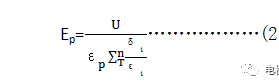
In formula (2):
U——external AC voltage (kV);
δι——insulation thickness of each layer (mm);
ει—dielectric constant of each layer of insulation;
εp—dielectric constant of p-layer insulation;
Ep—p-layer insulation electric field strength (kV/mm).
From formula (2), it can be seen that the field strength Ep borne by the P layer is inversely proportional to the dielectric constant εp of the insulating material of this layer. Therefore, if the δι and ει of various insulations are different, their breakdown strength Ep is also different. In order to make the withstand voltage safety margins of different insulation layers close, when selecting the insulation structure, the material composition with the product of Ep and ει as close as possible should be selected.
● Small dielectric loss
The insulation structure generates dielectric loss under the action of the alternating electric field. Although the average heat of the dielectric loss is not large, the heat is particularly concentrated at individual weak points. If the heat caused by the dielectric loss at the weak point exceeds the heat dissipated, the local temperature of the insulation will continue to rise, and the temperature rise will further increase the dielectric loss. The electromechanical performance of the insulation will drop sharply, and in severe cases, it will cause thermal breakdown of the local weak point. Therefore, the dielectric loss in high-voltage motors should not exceed the specified value.
● Good corona resistance
When high-voltage motors are running, corona may occur inside and on the surface of their insulation, causing accelerated aging and corrosion of the insulation. Therefore, for generators of 6.3 kV and above and motors of 6 kV and above, anti-corona measures must be taken for their coils. For the coils of 6 kV motors, anti-corona treatment is generally not required, but for motors in harsh operating environments or with larger capacities, anti-corona treatment should still be performed.
●Good thermal aging performance
The heat resistance of the insulation structure must meet the heat resistance level required by the product. Under the long-term operation temperature, the normal service life of the insulation can be guaranteed.
Motor insulation is usually divided into five heat resistance levels: A, E, B, F, and H. During operation, the temperature of the hottest point in the insulation of the motor winding shall not exceed the maximum temperature specified by the insulation level. Generally, a margin of 5~10℃ is required. If the insulation structure is composed of insulation materials of different heat resistance levels, its heat resistance level can be simulated and comprehensively evaluated through its structural model.
●Can withstand mechanical stress
The insulation of the coil must be able to withstand certain mechanical stress without breaking or causing harmful deformation. During operation, the insulation will be subjected to tension when the temperature changes due to the different expansion coefficients of the wire and insulation. The longer the motor, the greater the impact. Due to the electromagnetic force, the coil end will also vibrate, especially when the motor is subjected to short circuit, starting and braking current shocks, the electromagnetic force often causes the coil to deform. Therefore, the insulation is required to have a certain elasticity and mechanical strength.
